
November 23th, 2025
There are days in boat life that feel like milestones — not because everything goes smoothly, but because everything finally starts moving again. This sail was one of those days.
After months of refitting my Gib’Sea 402, replacing neglected rigging, installing new Sta-Lok terminals, fighting corrosion, and learning the hard way how many things can break on a 1990 sailboat… it was finally time.
Time to hoist the sails.
Time to trust the work I’d done.
And time to see whether this boat — and I — were ready to move again.
Leaving the Bay for the First Time in Months
The morning started like any other refit morning: tools everywhere, lines to re-check, and that familiar little voice saying,
“Did I forget something?”
But this time, instead of opening another bag of bolts, I released the mooring lines and pointed the bow toward open water.
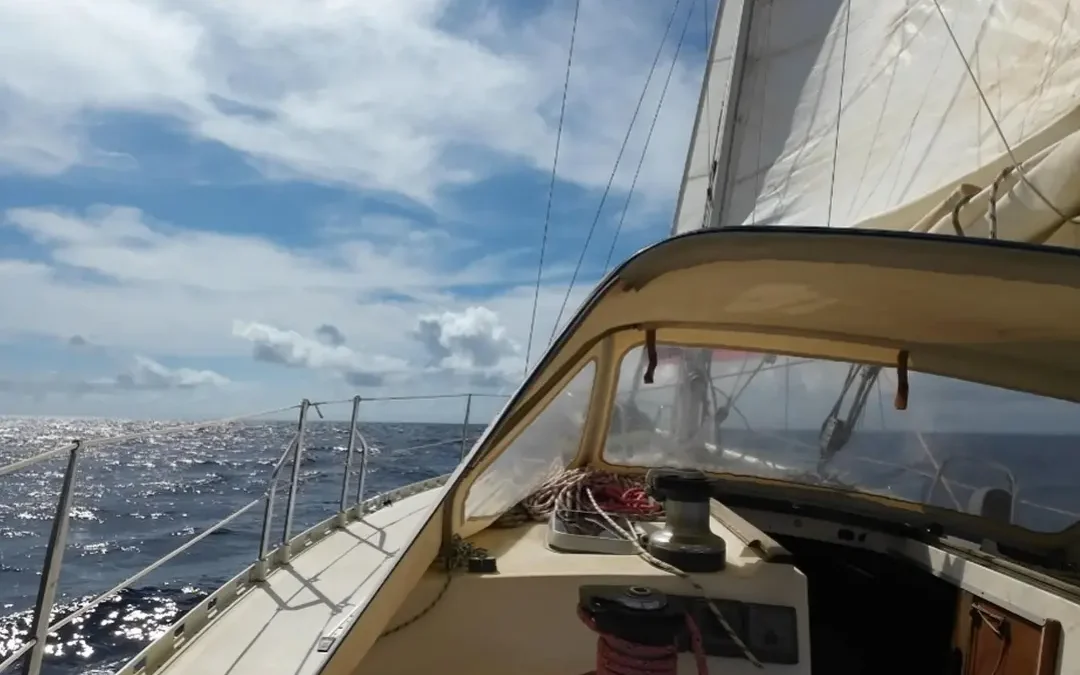
The wind filled the main.
The boat heeled.
The ocean opened up.
And just like that — after so many weeks tied to shore — I was sailing again.
The first feeling was pure happiness. The second was relief: the rigging held, nothing snapped, and the new terminals were doing their job. For the first few miles, everything ran smoothly.
But as every sailor knows, the real test begins once the excitement settles.
Performance Issues: Something Wasn’t Right
About an hour into the sail, I started noticing something odd. The boat felt heavy — not just “reef-the-main” heavy, but like she was dragging her feet. The pointing ability was terrible, the speed under sail didn’t match the wind, and the balance felt off.
At first, I blamed the chop. Then the wind angle. Then maybe I convinced myself it was my imagination.
But deep down, I knew the truth:
something wasn’t quite right with the mast setup.
I already suspected it before leaving — the mast alignment and shroud tension had been set roughly during the rigging repair, but not precisely. And a badly tuned rig can change a boat’s behavior completely.
So while I continued my 25-mile test sail toward Curaçao, I made mental notes:
- Leeward shrouds too loose
- Mast possibly leaning slightly to starboard
- Forestay tension not optimal
- Sails not forming the shape they should
Nothing dangerous — but definitely not good.
A boat is an honest teacher: if something is wrong, she won’t hide it.
Arriving in Spanish Water, Curaçao
By the time I reached Curaçao, the sun was dropping and Spanish Water opened in front of me like a quiet lagoon welcoming me back to stillness. It’s a natural harbor with calm conditions, sheltered water, and a whole community of cruisers — the ideal place to work on the next phase of the project.
I anchored, shut down the engine, and breathed for a moment.
The test sail didn’t go perfectly…
but I had learned exactly what I needed to fix.
And that is a win.
The Underwater Surprise: A Hull That Needed Help
Before sailing, I had wanted to check the hull, because let’s be honest — a boat sitting for months becomes a magnet for marine life. But the previous bay had extremely murky water. You could barely see your own hand underwater. Cleaning the hull there would have been impossible and unsafe.
Spanish Water, however, is different.
Clear. Calm. Perfect for diving.
So the next morning, mask on, scraper in hand, I jumped in to take a closer look.
What I found made everything suddenly make sense:
the hull was covered in a thick layer of barnacles, algae, and growth.
No wonder the performance was so bad.
I was basically dragging a reef around with me.
Scraper vs. Barnacles: The Real Battle
There’s something almost meditative about underwater hull cleaning… until the barnacles start fighting back. These little creatures cling to fiberglass like their lives depend on it — because, well, they do.
Scraping the hull turned into a workout that felt like fighting underwater gravel:
- Barnacles exploding off the hull
- Clouds of debris drifting away
- Arms burning after just a few minutes
- That strangely satisfying sound when the scraper hits clean hull
The difference was immediate. Even underwater, I could feel how much smoother the surface became.
Cleaning the hull is one of those unglamorous tasks nobody shows in the glossy sailing magazines — but it makes all the difference. And in my case, it explained at least half the performance issues.
Redoing the Mast Alignment
The next step was above water.
I spent half a day adjusting:
- Shroud tension, one turn at a time
- Mast rake
- Mast sideways alignment
- Forestay tension
- Backstay fine-tuning
It’s a slow process, a mix of feel, measurement, and instinct — but by the end of the afternoon, the boat looked straighter than ever.
Now I finally had a fair shot at a “real” test sail.
The Journey Continues
This wasn’t the perfect sail I hoped for.
But it was the sail I needed.
Boat life isn’t about flawless passages — it’s about learning, fixing, discovering, and improving. It’s about taking a neglected boat and bringing her back to life, one problem at a time.
The rigging is tuned.
The hull is clean.
The boat feels lighter, straighter, happier.
And now… I’m one big step closer to finally exploring the Caribbean the way I planned months ago.
Spanish Water will be my temporary home while the next projects unfold — and there are many more ahead.
But for the first time in a long while…
the boat and I feel ready.
👉 Subscribe to my YouTube channel so you don’t miss the next installment of “What Broke This Week?”
If you enjoy following my sailing adventures and DIY projects, please like, comment, and subscribe — it helps the channel grow and keeps the journey going.
Or join me on Patreon
Cheers
Paul – SY ANIMA